Angle Grinder vs Sander: Which Should You Use? (November 2026)
Use an angle grinder for fast stock removal on metal and masonry, and a sander for controlled finish work on wood and paint. The angle grinder vs sander choice comes down to how much material you need to take off and how smooth the result has to be.
On this page (8 sections)
Use an angle grinder for fast stock removal on metal and masonry, and a sander for controlled finish work on wood and paint. The angle grinder vs sander choice comes down to how much material you need to take off and how smooth the result has to be.
An angle grinder spins a hard disc at high speed and cuts or grinds aggressively. A sander moves an abrasive pad in a random orbit and takes off thin layers for a smooth surface.
They are not the same tool wearing different accessories. Speed, control, safety and the finish each leaves are different enough that most workshops end up with both.
 Best for heavy metal work
Milwaukee 2880-20 M18 FUEL Cordless Angle Grinder

Angle grinder vs sander: which should you reach for?
Reach for the angle grinder when you need to remove material fast, and the sander when you need a smooth surface. The job decides the tool, not the brand or the price.
| Job | Better tool | Why |
|---|---|---|
| Cutting rebar or pipe | Angle grinder | A cut-off wheel slices metal quickly |
| Grinding down a weld | Angle grinder | A grinding disc removes thick metal |
| Stripping rust or paint | Angle grinder | A wire cup or flap disc strips fast |
| Smoothing bare wood | Sander | The random orbit leaves a flatter finish |
| Prepping for paint | Sander | Even scuffing over a wide area |
| Sanding curves and hollows | Sander | A contour or detail sander reaches inside profiles |
| Polishing small parts | Sander | A mini orbital gives controlled polish |
The grinder wins wherever a lot of material has to go and the finish is rough. The sander wins wherever the surface has to look and feel even.
An angle grinder's wheel edge does the cutting. A sander's pad spreads pressure over a wider area, so it removes less material per pass but leaves fewer gouges.
That difference shows up in how each tool is built. A grinder's spindle takes a rigid wheel on a 5/8 in-11 thread, and the tool has to manage the torque that wheel creates.
A sander's pad is backed by a flexible interface, so the abrasive can follow a surface instead of digging into it.
How the two tools work differently
The grinder spins a bonded disc or wheel at high rpm, while the sander orbits a flexible abrasive pad. That difference in how the abrasive meets the surface explains most of the rest.
An angle grinder runs a 4-1/2 in or 5 in disc on a 5/8 in-11 spindle. The Milwaukee 2880-20 reaches 8,500 rpm and the DEWALT DWE4011 reaches 12,000 rpm.
At that speed the wheel bites into the material.
The disc face is rigid. Push it into steel and it grinds; push it into wood and it can gouge or burn unless you use a carving or sanding attachment.
A sander's pad flexes and its motion is random rather than a single fast spin. The ARBORTECH Contour Sander uses a 50 mm random orbit head that follows curves without scarring.
Smaller sanders work the same way at a smaller scale. The PROSHI runs 2 in and 3 in pads at up to 15,000 rpm in a random orbit for detail and spot work.
Why the orbit pattern matters for finish
The random orbit is the detail that separates a sander from a grinder in finish quality. Because the pad moves in a small loop while it spins, the abrasive never cuts the same line twice.
That is what stops swirl marks from building up.
A grinder's bonded disc cuts in one direction at one speed. On flat steel that is exactly what you want, because the cut is fast and predictable.
On wood the same motion leaves visible scratches that follow the disc.
The ARBORTECH's 50 mm head applies that orbit at a small scale, which is why it can finish a hollowed bowl or a carved profile without blemishing the grain. The flexible backing pad underneath lets the disc sit flat against a curve instead of bridging it.
Which tool suits metal work?
The angle grinder wins for metal every time. Cutting, grinding welds, blending and rust removal all need the speed and bite a hard disc gives.
A flap disc on a grinder can smooth a weld bead quickly. A wire cup strips paint and rust from steel.
A cut-off wheel slices through bar, pipe and sheet.
The Milwaukee 2880-20 suits this work with an electronic clutch for kickback protection and an anti-vibration side handle. When a disc binds in metal, that clutch helps cut the power before the tool twists.
Its overload protection matters for long grinding sessions too. It is built to protect the motor when the disc is pushed hard for extended periods, which is the normal life of a metal grinder.
A sander is a poor fit for heavy metal work. It removes too little material per pass and its pad wears out quickly on steel.
Mini sanders do have a place in polishing small metal parts and cleaning tight spots.
The PROSHI's angled head reaches inside brackets and corners where a full-size grinder cannot. That makes it useful for detail polish rather than heavy stock removal, and its built-in regulator lets you slow the speed for a finish pass.
If you are weighing a grinder against a rotary tool for metal, our comparison of angle grinder vs die grinder covers the smaller-tool option.
Which tool suits wood and paint?
The sander wins for wood and paint prep, but the grinder has a niche for rough shaping. A grinder with a carving disc removes wood fast, while a sander makes the surface smooth enough to finish.
The ARBORTECH Contour Sander is the clear example. Its 50 mm random orbit head and flexible backing pad finish free-form internal curves, shells and deep internal profiles without scarring or blemishing the wood.
Its 8 cm shaft reaches into deep hollows that a flat pad cannot touch. That is detail sanding and spot sanding work a standard sander skips.
The kit supports that role with a sanding paper set that runs from coarse to fine, with pads listed at K80, 120, 180, 240, 320, 400 and 600 grit. You can shape rough wood and work down to a fine finish with the same attachment, stepping through the grits.
Because it fits most standard 100 mm or 115 mm grinders, it can also run on the Milwaukee or the DEWALT in this set. The attachment is rated to 12,000 rpm, which covers the 8,500 rpm Milwaukee and sits at the DEWALT's top speed.
For flat panels, paint prep and general smoothing, a dedicated orbital sander is the simpler choice. The PROSHI handles small spots and tight areas well, but its mini pads cover less area than a full-size sander.
A grinder alone will rough-shape wood with the right disc, but it leaves a rough, gouged surface. Plan on a sander to follow up if the wood will be seen or finished.
The safety differences that matter most
The angle grinder carries more risk per minute of use, because a hard disc at 8,500 to 12,000 rpm stores a lot of energy. A sander's random orbit and softer pad make it the gentler tool for a beginner.
The grinder needs a guard, eye protection and firm two-handed control. A binding disc can kick back, which is why the Milwaukee's electronic clutch matters.
The sander's risk is lower but not zero. Dust is the bigger issue with wood and paint, so wear a mask and connect dust extraction where the tool allows.
Paddle vs slide switch on a grinder
The Milwaukee 2880-20 uses a no-lock paddle switch. Power cuts as soon as you release the handle, which is the safer layout when a disc binds.
If you are unsure which switch type suits your work, our angle grinder paddle switch vs slide switch guide compares the two.
The DEWALT DWE4011 uses a slide switch. It stays on until you move it, which some users prefer for long grinding sessions.
Either way, never remove a grinder's guard for sanding attachments that require it to be off. Follow the attachment maker's instructions.
Air power adds its own checklist
The PROSHI is air powered, and that changes the safety routine. It needs a clean, lubricated air supply from a compressor, and the maker asks for 2 to 3 drops of oil through the quick connector before use.
Run the tool for a few seconds after oiling so the oil spreads through the motor. An oily, well-lubricated air sander runs cooler and holds speed better, and the built-in regulator lets you dial the speed down for polishing instead of running flat out.
None of that makes it a replacement for eye protection. A mini pad at 15,000 rpm still throws debris, so treat it like any other high-speed tool.
Power, cord and where you work
Choose corded for long sessions in one spot and cordless for mobility. The grinder you buy should match how often you use it and how far you work from an outlet.
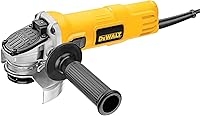
The DEWALT DWE4011 runs on a 7 amp cord. It has no battery to swap during a long grinding job and its one-touch guard adjusts without tools.
The corded grinder also saves time on wheel changes. Its quick-change wheel release lets you swap a disc without a wrench, and a hex wrench for the rest of the work is a common tool box item rather than a special spanner.
The Milwaukee 2880-20 runs on any M18 battery. It is sold as a bare tool, so you supply the battery and charger.
In return you get freedom from a cord on ladders and in awkward spots.
The sanders split the same way. The PROSHI is air powered and needs a compressor.
The ARBORTECH is an attachment that runs on whatever grinder you already own, so its power source is your grinder's.
That last point is worth planning around. An attachment inherits your grinder's speed, so a variable-speed grinder gives you more control over a contour sander than a single-speed model does.
If you already own a grinder and want to sand, the attachment route is the cheapest way in. If you sand often and work flat surfaces, a dedicated sander earns its place.
Which grinder and sander should you buy?
Buy the Milwaukee 2880-20 as the grinder and the ARBORTECH Contour Sander as the sanding attachment for most mixed workshops. Together they cover fast metal work and controlled curved-wood finishing.
The Milwaukee 2880-20 scores highest here because its electronic clutch, anti-vibration handle and overload protection make it the safest and most capable general grinder in this set. It is the grinder to pick for metal work.
For sanding, the ARBORTECH adds detail finishing to an angle grinder you already own. It reaches curves and hollows that flat sanders miss, which is where the grinder-to-sander conversion makes the most sense.
If you mostly grind metal and want a corded tool, the DEWALT DWE4011 is the simple all-day option. If you polish small parts and tight corners, the PROSHI mini orbital covers that niche.
Our roundups of the best DeWalt angle grinders and the best Milwaukee angle grinders compare the wider ranges if neither pick fits your budget.
So which one do you need?
Pick the angle grinder for cutting and grinding metal or masonry, and pick the sander for smoothing wood, paint and detail work. Most readers who do both should buy the grinder first and add a sanding attachment later.
The angle grinder vs sander decision is really about finish. If the surface only has to be cut or roughed down, the grinder is the faster tool.
If it has to look even and feel smooth, the sander does that better.
Start with the Milwaukee 2880-20 if metal work is the main job. Add the ARBORTECH Contour Sander when you need to finish curves and hollows in wood.
Go straight to a sander if wood and paint are all you touch.
Frequently asked questions
Is an angle grinder better than a sander for wood?
An angle grinder removes wood fast with a carving disc or flap wheel, but it leaves a rougher surface. A random orbit sander gives a smoother, flatter finish.
Many woodworkers use a grinder to rough out a shape and a sander to finish it.
Can you use an angle grinder as a sander?
Yes, with the right attachment. A backing pad and sanding disc, or a contour sander like the ARBORTECH, turns a grinder into a sander.
Control is harder than with a purpose-built sander, so practice on scrap first.
Which is safer for a beginner, an angle grinder or a sander?
A sander is generally the gentler tool for a beginner because its pad moves in a random orbit and removes less material per pass. An angle grinder spins a hard disc at 8,500 to 12,000 rpm, so it needs firmer control, eye protection and a guard.
Do I need both tools?
If you cut metal and also finish wood or paint, yes. A grinder handles cutting, grinding and rust removal, while a sander handles smoothing and prep.
Buying both costs more, but each does its job better than the other.