7 Best Angle Grinders for Cutting Concrete (November 2026)
The best angle grinders for cutting concrete include the AVID POWER Angle Grinder for concrete cutting, the SHALL 7.5Amp 4-1/2 Inch 12000 RPM Angle for guarded cutting, and the DEWALT DCG413B 20V MAX Brushless Angle Grinder for work without an outlet.
On this page (5 sections)
The best angle grinder for cutting concrete for most people is the AVID POWER Angle Grinder. Its 900W 7.5-Amp motor runs up to 12,000 RPM, and the tool-free guard turns to block sparks and concrete dust from your side.
That combination covers the job: enough speed for a diamond disc to cut cleanly, a guard that moves with the cut, and a side handle you can fit on either side for a steady grip.
Concrete is a different job from cutting steel. The disc works by grinding a kerf through stone, so the tool needs steady power, a guard close to the surface, and a firm two-handed hold.
If you want a diamond blade in the box, pick the Makita 9557PBX1. If you want a lighter cutting grinder with a cutting guard fitted from the start, pick the SHALL.
Our picks at a glance
-
1

-
2

-
3
 Best for work without an outlet
DEWALT DCG413B 20V MAX Brushless Angle Grinder
9.1/10 our score
See it on Amazon
- 4
 Check it
DEWALT DWE4011 4-1/2 Inch Corded Angle Grinder
Best for fast wheel changes - 5
 Check it
Makita 9557PBX1 Paddle Switch Cut-Off Grinder
Best for a diamond blade in the box - 6
 Check it
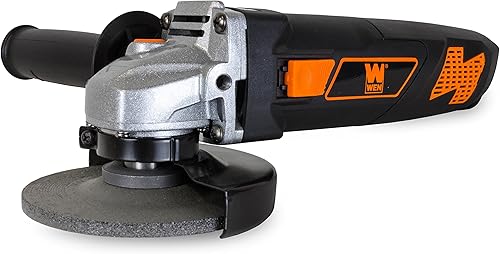
WEN 7-Amp Angle Grinder with 4-1/2-Inch Wheel
Best for a budget first concrete cut - 7
 Check it
DongCheng Angle Grinder 4-1/2 inch
Best for beginners who want a safety switch
The best angle grinders for concrete cutting
The AVID leads because its motor and guard suit concrete directly, while every other pick answers a narrower need. Read each one against the cut you actually plan to make.
AVID POWER Angle Grinder: Best for concrete cutting
- 900W 7.5-Amp motor
- 12
- 000 RPM
- Tool-free adjustable guard
- 2-position side handle
A 900W motor and tool-free guard make this the most practical corded grinder here for running a diamond disc through concrete.
Pros
- Tool-free guard adjusts to any cutting angle
- 2-position handle suits either hand
- Extra carbon brushes included
Cons
- Diamond blade is not included
- 5.1 lb is the heaviest corded body here
For concrete tasks, the AVID POWER Angle Grinder gives you what a diamond disc needs. The 900W 7.5-Amp motor holds 12,000 RPM, so the disc keeps its speed as it meets aggregate instead of bogging down.
It runs on 120V corded power and uses a standard 4-1/2 in wheel on a 5/8-11 threaded spindle, the spindle size most diamond discs are sold for.
AVID POWER lists masonry work in the tool's uses, including grinding concrete to level uneven areas and smoothing masonry joints. A diamond disc is not included, so budget for one before your first cut.
The kit does ship with two metal cutting wheels, two grinding wheels, a spanner and spare carbon brushes.
The tool-free guard adjusts to multiple angles, which means you can set it to deflect dust away from your line of sight. The 5.1 in side handle fits on either side, so left-handed users get the same two-handed control.
At 5.1 lb, it is the heaviest corded grinder here. That weight steadies the tool on a long slab cut, but it tires your arm sooner overhead or on a wall.
If you work mostly above shoulder height, the lighter SHALL earns its place.
SHALL 7.5Amp 4-1/2 Inch 12000 RPM Angle: Best for guarded cutting
- 7.5-Amp 900W motor
- 12
- 000 RPM
- Two tool-free wheel guards
- Weight 3.7 lb
Two separate guards let you cut and grind without swapping one part mid-job, and the lighter body tires hands less on long runs.
Pros
- Cutting guard and grinding guard both included
- Lighter than the AVID
- Non-slip 2-position handle
Cons
- Diamond blade is not included
- Slide switch lacks a paddle-style trigger
The SHALL is the pick when you want a guard already set up for cut-off work. Two tool-free guards come in the box, one for cutting and one for grinding, so you are not swapping parts between cutting a slab and cleaning up the edge.
A dedicated cutting guard also means you keep the shield as close to the surface as the guard allows, which is where dust control starts.
Its 7.5-Amp, 900W motor also reaches 12,000 RPM. At 3.7 lb, the body is lighter than the AVID's 5.1 lb, which helps on overhead or one-handed spots where you can still keep a second hand on the handle.
The narrow body and rubber-lined handle are built for a firm grip through a long cut.
The slide switch has a lock-off and on position, so you set it before the disc touches concrete. The raised spindle lock makes wheel changes easier with gloves on, and the 7/8 in arbor with a 5/8-11 spindle fits the same discs as the AVID.
SHALL does not include a diamond disc, so the blade is a separate buy just as it is for the AVID. Its three cutting discs ship wrapped in clear film, so tear that off when the box arrives.
DEWALT DCG413B 20V MAX Brushless Angle Grinder: Best for work without an outlet
- Brushless motor
- Kickback Brake
- Brake stops wheel in 2 seconds or less
- Tool only
The Kickback Brake shuts the tool down when the wheel pinches, which matters when a disc grabs in a concrete cut.
Pros
- Brushless motor needs no brush changes
- Kickback Brake and electronic brake
- Cordless freedom on slab edges
Cons
- Battery and charger sold separately
- No corded power for long cuts
The DEWALT DCG413B answers the cut you can't bring a cord to: a fence post base at the back of a lot, a threshold outside a garage door, or a slab edge far from an outlet. The Kickback Brake engages when a pinch or bind-up is sensed, then stops the wheel and shuts the grinder off.
That matters on concrete, where a disc can grab in a deep kerf.
The brake stops the wheel in 2 seconds or less on average, DEWALT says, so you are not waiting with a spinning disc near your feet. The two-stage trigger needs two actions to start the tool, and the E-Switch protection means the trigger must be cycled after a power interruption, so the grinder does not restart on its own.
The brushless motor needs no brush changes, and the tool weighs 3.8 lb. It runs on a 20V MAX battery, sold separately along with the charger, so the real cost sits above the corded picks.
Its 4-1/2 in wheel size takes the same discs as the rest of the group.
For long cuts across a whole slab, the corded picks run all day without a battery swap. For short, awkward cuts, this is the one to carry out.
A 3-year limited warranty backs the tool.
DEWALT DWE4011 4-1/2 Inch Corded Angle Grinder: Best for fast wheel changes
- 7-Amp motor
- 12
- 000 RPM
- One-Touch guard
- Quick-Change wheel release
A slim body and a guard you reposition without a tool cover the concrete basics, and the Quick-Change release speeds up disc swaps.
Pros
- One-Touch guard needs no wrench
- Quick-Change wheel release
- Slim ergonomic body
Cons
- Lower amp rating than the top two picks
- Diamond blade is not included
The DEWALT DWE4011 suits someone who will swap discs often. Its Quick-Change wheel release lets you remove the wheel without a wrench, and the One-Touch guard moves without a tool, so switching from a diamond cutting disc to a grinding cup takes seconds.
The hex wrench in the box replaces the usual spanner, and DEWALT points out that most tool boxes already hold one.
The 7-Amp motor runs to 12,000 RPM, enough for a 4-1/2 in diamond disc in masonry and concrete. The slim body weighs 3.9 lb, between the lighter SHALL and the heavier AVID.
The 5/8 in 11 spindle thread accepts a wide range of 4-1/2 in accessories, so diamond discs fit without an adapter.
DEWALT includes a depressed center wheel, a One-Touch guard and a hex wrench. A diamond blade is separate.
It gives up half an amp to the AVID and SHALL, so on deep cuts in hard concrete the disc may slow sooner. For patios, stucco and shallow chase cuts, it keeps pace.
The Quick-Change release is the reason to pick it over the AVID if you will change discs between cuts.
Makita 9557PBX1 Paddle Switch Cut-Off Grinder: Best for a diamond blade in the box
- 7.5-Amp motor
- 11
- 000 RPM
- Turbo rim diamond blade included
- Labyrinth motor seal
It arrives with a turbo rim diamond blade and a cut-off guard, so you can start on concrete without a separate disc purchase.
Pros
- Diamond blade and cut-off guard included
- Large paddle switch for control
- Labyrinth construction keeps dust out of the motor
Cons
- Heaviest tool in this roundup
- Lower top speed than the 12
- 000 RPM picks
The Makita 9557PBX1 is the pick when you want to start cutting concrete on day one. It ships with a 4-1/2 in turbo rim diamond blade and a cut-off wheel guard, plus five 24-grit grinding wheels and an aluminum case.
That case matters on a job site where dust and knocks are the norm, and the spare grinding wheels let you move from cutting to surface cleanup without another order.
The 7.5-Amp motor runs to 11,000 RPM. That is a step below the 12,000 RPM picks here, but the diamond blade in the box offsets it: the disc and guard are matched to the tool from the start.
The turbo rim is built for constant contact with the material, so it leaves a smoother cut edge than a segmented blade.
Its large paddle switch and lock-on feature suit long, continuous cuts, and the lock-on keeps the motor running without holding the switch. Labyrinth construction seals the motor and bearings from dust, which matters in a job that throws grit.
The protective varnish on the armature adds another layer against debris.
At 4.5 lb it is the heaviest grinder in this roundup. The guard needs a wrench to adjust, so you set it and leave it.
For someone who cuts the same kind of line all day, that is a small price for the blade and case.
WEN 7-Amp Angle Grinder with 4-1/2-Inch Wheel: Best for a budget first concrete cut
- 7-Amp motor
- 11
- 000 RPM
- Arbor adapter for 5/8 and 7/8 in
- Two-year warranty
The 7-amp motor covers occasional concrete work, and the arbor adapter lets you fit both common blade bore sizes.
Pros
- Fits 5/8 and 7/8 in arbors
- Two-year warranty
- Reversible side handle
Cons
- Lowest top speed among the corded picks
- Heavier than the AVID and SHALL
The WEN 944 is the budget route into concrete cutting. A 7-Amp motor reaches 11,000 RPM, and an arbor adapter lets the tool take both 5/8 and 7/8 in wheels, so you can fit a diamond blade you already own.
That adapter is the practical draw here, since diamond discs come in both bore sizes and a mismatch usually means a second purchase.
The reversible handle mounts on either side, and a lock-on side switch keeps the tool running during a long cut. The rubber grip lining is there to cut vibration fatigue.
WEN backs it with a two-year warranty.
At 4.6 lb it is heavy for its class, and 11,000 RPM is the lowest top speed among the corded picks here, along with the Makita. On a shallow groove in a patio, that speed is fine.
On a deep cut in dense concrete, the disc will feel slower.
A 4.5 in grinding disc, adjustable guard and wrench come in the box. A diamond blade does not.
If you already own a blade, this is the cheapest way into the job; if not, the Makita kit saves you the separate buy.
DongCheng Angle Grinder 4-1/2 inch: Best for beginners who want a safety switch
- 800W 6.7-Amp motor
- 11
- 800 RPM
- No-lock instant-stop paddle switch
- 9 ft cord
The paddle switch stops the tool the moment you let go, which suits a first concrete cut on a patio or garden wall.
Pros
- No lock-on paddle switch
- Two interchangeable guards
- Long 9 ft cord
Cons
- Lowest score in this group
- No diamond blade included
The DongCheng suits a first concrete cut where a forgotten switch could mean a spinning disc on the ground. Its no-lock instant-stop paddle switch cuts the motor the moment you release the grip, so there is no lock-on position to leave engaged.
For a beginner working near a wall or a step, that is the feature that matters most.
The 800W 6.7-Amp motor reaches 11,800 RPM. Two interchangeable guards cover cutting and grinding, so the cutting guard stays fitted when you are chasing a line.
The 9 ft cord reaches past a short extension on a driveway job, and the multi-hole venting is there to keep the motor cooler through longer runs. DongCheng says the precision spiral-bevel gears boost torque resistance.
The paddle switch design is the reason to choose it over the WEN. It gives up power to the 7.5-Amp picks, at 800W against 900W, so deep cuts in hard concrete take longer.
At 4.2 lb it sits between the SHALL and the AVID in weight.
DongCheng includes cutting, grinding and flap discs, but no diamond blade. A 5-year limited warranty backs the tool, the longest in this roundup.
How these grinders compare for concrete
The top picks share a 12,000 RPM ceiling, and the differences come down to guards, weight and whether a diamond blade ships with the tool. The table sets the main specs side by side so you can match one to the cut you plan.
| Product | Best for | Power source | Top speed | Wheel size | Our score |
|---|---|---|---|---|---|
| AVID POWER Angle Grinder | concrete cutting | Corded electric | 12,000 RPM | 4-1/2 in | 9.7 |
| SHALL 7.5Amp 4-1/2 Inch 12000 RPM Angle | guarded cutting | Corded electric | 12,000 RPM | 9.3 | |
| DEWALT DCG413B 20V MAX Brushless Angle Grinder | work without an outlet | Battery powered (20V MAX) | 4-1/2 in | 9.1 | |
| DEWALT DWE4011 4-1/2 Inch Corded Angle Grinder | fast wheel changes | Corded electric | 12,000 RPM | 8.9 | |
| Makita 9557PBX1 Paddle Switch Cut-Off Grinder | a diamond blade in the box | Corded electric | 11,000 RPM | 8.4 | |
| WEN 7-Amp Angle Grinder with 4-1/2-Inch Wheel | a budget first concrete cut | Corded electric | 11,000 RPM | 8.3 | |
| DongCheng Angle Grinder 4-1/2 inch | beginners who want a safety switch | Corded electric | 11,800 RPM | 8.1 |
Our score weighs specs, features and buyer feedback against what you're shopping for. For concrete cutting, motor output, top speed, guard design and dust protection carry the most weight; included accessories break ties.
A tool that needs a diamond blade before it can cut concrete starts behind one that ships with a matched blade and guard. Weight counts next, since a heavy grinder held at arm's length on a wall slows a long cut.
The corded tools cluster near the top because concrete work runs long enough that a steady power supply matters more than the freedom of a battery.
What actually matters when you cut concrete
A concrete disc needs speed and steady torque, not a long feature list. Check the motor, the guard and the disc rating before anything else, because those three decide whether the cut goes cleanly.
How much power do you need for concrete?
A 900W, 7.5-Amp motor is the practical target for a 4-1/2 in diamond disc in concrete. The AVID, SHALL and Makita all hit that figure, and the DEWALT DWE4011 sits close at 7 Amps.
The WEN and DongCheng run a step below at 7 and 6.7 Amps.
Below that, the disc slows in a deep kerf and you lean on the tool, which is when a wheel can bind. If most of your work is shallow chase cuts or stucco, a 6.7-Amp tool like the DongCheng does the job.
For a full slab cut in hard concrete, the 7.5-Amp motors hold speed longer.
Does top speed matter more than amps?
Both matter, and they work together. A 12,000 RPM motor lets a diamond disc cut at its rated surface speed, which is where it cuts fastest and coolest.
Amps decide how well the motor holds that speed when the disc meets stone.
The Makita and WEN run to 11,000 RPM, and the DongCheng to 11,800 RPM. That gap shows up most in hard, dense concrete, where a slower disc loads the motor more.
If you are cutting a few short lines in a patio, the difference is slight. If you are cutting a long run in a slab, the 12,000 RPM tools finish with less strain on the motor.
Which guard setup is right for cut-off work?
Use a guard rated for cut-off wheels and set it between you and the dust. The SHALL's cutting guard and the Makita's cut-off guard are made for this.
The AVID's tool-free guard turns to multiple angles, so you can move it as you change your cutting position.
The angle of the guard matters because concrete dust and chips leave the wheel in a fan. Set the guard so that fan points away from your face and arms.
Never cut with the guard removed, even for a short pass. The DEWALT DWE4011's One-Touch guard and the WEN's adjustable guard both let you set the position and leave it.
Corded or cordless for concrete cutting?
A corded grinder is the better default for concrete. Long cuts in a slab take minutes, and a corded 7.5-Amp tool holds its speed the whole way.
A battery tool can fade toward the end of a long cut, and swapping a pack mid-kerf means pulling the disc out and starting again.
The DEWALT DCG413B is the exception: its Kickback Brake and cordless body suit short cuts away from power. For anything longer than a threshold or a post base, bring a cord.
Our cordless angle grinder buying guide covers battery and runtime decisions in more detail.
Which diamond blade and disc size do you need?
Match the blade to a 4-1/2 in grinder and to the arbor size. The AVID, SHALL and DEWALT DWE4011 take a 5/8-11 threaded spindle; the WEN fits both 5/8 and 7/8 in arbors through its adapter.
The SHALL's 7/8 in arbor covers the common diamond disc bore.
Use a diamond blade rated for concrete, not a metal cut-off wheel. A segmented rim cuts faster; a turbo rim like the Makita's leaves a smoother finish.
For a straight cut in a slab, a segmented blade clears dust and runs cooler. For a visible edge, a turbo or continuous rim gives a cleaner line.
Whatever blade you fit, check its RPM rating against your grinder's top speed before you start.
Do you need a variable speed grinder for concrete?
For straight cuts, no. A fixed-speed 12,000 RPM motor gives the disc the speed it wants.
Every corded pick here runs at one speed, and that is fine for chasing a straight line across a slab.
Variable speed helps when you start a groove or work along an edge, where a slow start keeps the disc on line. A slow start also helps when you first touch the blade to the surface, since it keeps the disc from skipping across the concrete.
Our roundup of the best variable speed angle grinders covers the models built for that kind of control. If you cut mostly straight and deep, the fixed-speed AVID does the job without that extra dial.
Safety steps before the disc touches concrete
Concrete cutting throws silica dust and chips, so set up the job before you pull the trigger. Wear a respirator rated for silica dust, a face shield and hearing protection, and cut outdoors or wet the cut to hold dust down.
A face shield over safety glasses covers the chips that fly back toward your face.
Check the diamond blade for cracks and make sure it is rated for the RPM of your grinder. Fit the guard for cut-off work and keep both hands on the tool through the cut.
A two-handed grip on the side handle is what stops the grinder twisting if the disc grabs.
Let the disc reach full speed before it touches concrete, and do not twist the tool in the kerf. If the disc binds, release the switch and let it stop before you pull it free.
The DEWALT DCG413B's Kickback Brake is built for exactly that moment. A no-lock switch like the DongCheng's also helps, since the motor stops when your hand leaves the tool.
Which grinder fits your concrete job?
Choose the AVID POWER Angle Grinder if you want the strongest all-round corded setup for concrete cuts, with a tool-free guard and a 12,000 RPM motor. Go with the Makita 9557PBX1 when you want a diamond blade and cut-off guard in the case on day one.
The Makita's 11,000 RPM motor is a step down, but the matched blade and guard make it the faster start on a real job.
Pick the SHALL if a dedicated cutting guard and a lighter body matter most. Its second guard and 3.7 lb frame suit long cutting sessions where arm fatigue sets in.
The DEWALT DCG413B is the one for short cuts away from an outlet, and its Kickback Brake adds a layer of safety a corded tool lacks.
For a first tool on a budget, the WEN 944 keeps costs down and still fits a diamond blade. If brand support matters to you, browse our picks for the best DeWalt angle grinders and the best Milwaukee angle grinders before you decide.
Either way, buy the diamond blade first and match its arbor and RPM rating to the grinder you choose.
Our top 3 picks at a glance
-
1
-
2
-
3
Best for work without an outlet
DEWALT DCG413B 20V MAX Brushless Angle Grinder
9.1/10 our score
See it on Amazon
Frequently asked questions
What size angle grinder do I need to cut concrete?
A 4-1/2 in grinder handles most concrete cutting jobs in masonry, stucco and slabs. The 4-1/2 in picks here take diamond discs on a 7/8 in arbor or a 5/8-11 spindle, and the WEN's adapter fits both bores.
Can I cut concrete with a standard grinding wheel?
No. Use a diamond blade rated for concrete and a guard set for cut-off work.
Standard metal grinding wheels are not made for masonry and can break under the load of a deep concrete cut.
Is a cordless grinder strong enough for concrete?
Yes for short runs, edges and detail work. The DEWALT DCG413B runs brushless on a 20V MAX battery.
For long cuts in thick concrete, a corded 7.5-Amp grinder keeps power steady without battery changes.
What safety gear should I wear when cutting concrete?
Wear safety glasses and a face shield, hearing protection, gloves and a respirator rated for silica dust. Cut outside or wet the cut to hold dust down, and keep the guard between you and the disc.


