10 Best Bench Grinders for Home Shops (October 2026)
The best bench grinders for home shops include the DEWALT DW758 8-Inch Bench Grinder for general shop work, the RIKON 80-805 8-Inch Low Speed Bench Grinder for tool sharpening, and the DEWALT DW756 6-Inch Bench Grinder for compact benches.
On this page (13 sections)
- How we chose these bench grinders
- Which bench grinder is best for general shop work? DEWALT DW758
- Which bench grinder suits tool sharpening? RIKON 80-805
- Is the DEWALT DW756 a good fit for a compact bench?
- When does the JET JBG-8 make sense?
- Is the WEN BG4282 useful for grinding in dim areas?
- Who should choose the BUCKTOOL low-speed grinder?
- Does the WEN BG625V offer useful speed adjustment?
- Is the BUCKTOOL dual-speed combo right for a polishing station?
- Can the Genesis GBG800L light a focused work area?
- Is the Ryobi BG612GSB enough for basic upkeep?
- How do you choose the best bench grinder for your work?
- Which bench grinder should you choose?
The DEWALT DW758 is the best bench grinder for most home shops that need a fast, general-purpose station. If sharpening is the main job, choose a low-speed RIKON or BUCKTOOL; for a compact space with speed adjustment, consider the WEN BG625V.
A bench grinder is a fixed tool for sharpening, deburring, shaping and cleaning small metal parts. The right choice depends on the work you repeat, the wheel size and speed that fit it, and whether your bench can hold the machine securely.
For examples of common jobs, see what a bench grinder is used for. The bench grinder wheel guide explains grit and wheel types, while angle grinder sizes and uses can help if you need a portable tool for work away from the bench.
Our picks at a glance
-
1

-
2
 Best for tool sharpening
RIKON 80-805 8-Inch Low Speed Bench Grinder
8.6/10 our score
See it on Amazon -
3

- 4
 Check it
JET JBG-8 8-Inch Bench Grinder
Best for fixed workstations - 5
 Check it
WEN BG4282 8-Inch Bench Grinder
Best for lit grinding - 6
 Check it
BUCKTOOL 8-Inch Low Speed Bench Grinder
Best for wide-wheel edges - 7
 Check it
WEN BG625V 6-Inch Variable Speed Bench Grinder
Best for speed control - 8
 Check it
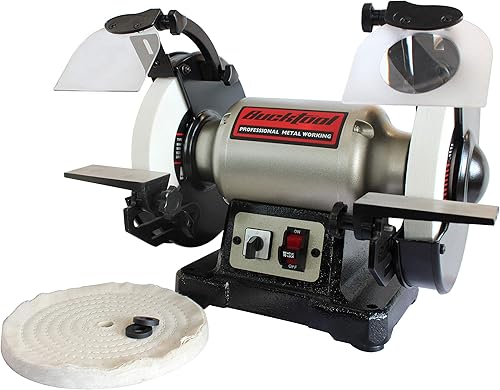
BUCKTOOL 8-Inch Dual Speed Bench Grinder Buffer Combo
Best for polishing add-ons - 9
 Check it
Genesis GBG800L 8-Inch Bench Grinder
Best for aimed lighting - 10
 Check it
Ryobi BG612GSB 6-Inch Bench Grinder
Best for simple upkeep
How we chose these bench grinders
The best bench grinder for a home shop matches the work you do most, the space you have and the control you want while sharpening. We compared wheel size, speed, motor details, included wheels, rests, lighting and other stated features.
Faster grinders can suit routine stock removal and cleanup. Lower speeds can be easier to manage when sharpening, especially when you want to reduce heat buildup at an edge.
We weighed each model’s features against common home shop needs and gave more weight to clear, task-relevant information. Check your chosen grinder’s manual and wheel markings before buying replacement wheels or setting up the machine.
| Product | Best for | Wheel size | Motor | Speed | Our score |
|---|---|---|---|---|---|
| DEWALT DW758 8-Inch Bench Grinder | general shop work | 8 in | 3/4 HP induction | 3,600 rpm | 8.9 |
| RIKON 80-805 8-Inch Low Speed Bench Grinder | tool sharpening | 8 in | 1/2 HP | 1,750 rpm | 8.6 |
| DEWALT DW756 6-Inch Bench Grinder | compact benches | 6 in | 5/8 HP induction | 3,450 rpm | 8.5 |
| JET JBG-8 8-Inch Bench Grinder | fixed workstations | 8 in | 3,450 rpm | 8.3 | |
| WEN BG4282 8-Inch Bench Grinder | lit grinding | 8 in | 4.8 amp | Up to 3,450 rpm | 8.2 |
| BUCKTOOL 8-Inch Low Speed Bench Grinder | wide-wheel edges | 8 in | 3/4 HP | 1,750 rpm | 8.0 |
| WEN BG625V 6-Inch Variable Speed Bench Grinder | speed control | 6 in | 2.5 amp | 2,000 to 3,400 rpm | 7.9 |
| BUCKTOOL 8-Inch Dual Speed Bench Grinder Buffer Combo | polishing add-ons | 8 in | 1/2 HP | 1,725 and 3,450 rpm | 7.8 |
| Genesis GBG800L 8-Inch Bench Grinder | aimed lighting | 8 in | Induction motor | 7.6 | |
| Ryobi BG612GSB 6-Inch Bench Grinder | simple upkeep | 6 in | 7.4 |
Which bench grinder is best for general shop work? DEWALT DW758
DEWALT DW758 8-Inch Bench Grinder: Best for general shop work
- 8-inch wheels
- 3/4 HP induction motor
- 3,600 rpm
- 12-1/2-inch distance between wheels
The 8-inch wheel size, 3/4 HP motor and wide space between wheels make this a flexible choice for common home shop grinding jobs.
Pros
- 3/4 HP induction motor
- 12-1/2 inches between wheels
- Precision-machined aluminum tool rests
Cons
- High-speed operation may be less suited to heat-sensitive sharpening
- Larger 8-inch format needs bench space
The DW758 suits a home shop that needs one grinder for routine metal work. Its 3/4 HP induction motor runs at 3,600 rpm, and its 8-inch wheels provide a larger grinding surface than the 6-inch options.
DEWALT includes 36- and 60-grit wheels, eye shields, spark deflectors and tool rests. The precision-machined aluminum rests help position work, and the 12-1/2-inch distance between wheels leaves space for longer pieces.
Its cast iron base and motor housing make it a sensible choice for a station that will stay in one place. Rear exhaust ports are built into the wheel guards.
Choose the DW758 for general grinding, deburring and shop cleanup when faster material removal matters. Skip it if most of your work is careful sharpening and you’d rather have a dedicated low-speed machine.
Which bench grinder suits tool sharpening? RIKON 80-805
RIKON 80-805 8-Inch Low Speed Bench Grinder: Best for tool sharpening
- 1/2 HP motor
- 1,750 rpm
- 60- and 120-grit wheels
- Diamond wheel dresser
Its 1,750 rpm speed and included 60- and 120-grit wheels suit sharpening and controlled grinding. Adjustable rests include a drill-bit groove.
Pros
- Low-speed motor for sharpening
- Two wheel grits included
- Diamond wheel dresser included
Cons
- Lower speed removes material more slowly
- Heavier than some compact options
The RIKON 80-805 is the clearest fit here for regular sharpening because its motor runs at 1,750 rpm. RIKON says the low speed helps reduce heat buildup, and it offers a slower pace than the general-purpose grinders.
It comes with 60- and 120-grit wheels for rough shaping and finer sharpening. The left tool rest has a groove for drill-bit sharpening, and the included diamond dresser helps maintain the wheel faces.
The cast iron base has anti-vibration rubber feet and mounting holes for a bench or stand. Adjustable eye shields and spark arrestors are included.
Choose the RIKON if sharpening is a frequent task and you want a slower wheel speed with two grits. Skip it if fast stock removal is your main goal, since the slower speed takes a more measured pace.
Is the DEWALT DW756 a good fit for a compact bench?
DEWALT DW756 6-Inch Bench Grinder: Best for compact benches
- 6-inch wheels
- 5/8 HP induction motor
- 3,450 rpm
- 12-1/2-inch distance between wheels
This 6-inch model has a 5/8 HP induction motor and the same stated distance between wheels as the larger DW758, in a smaller wheel format.
Pros
- Smaller 6-inch wheel size
- 5/8 HP induction motor
- Adjustable aluminum tool rests
Cons
- Smaller wheels than 8-inch models
- High-speed setup is less suited to slow sharpening
The DW756 puts a 6-inch wheel format in a durable shop grinder with a 5/8 HP induction motor. It runs at 3,450 rpm and includes 36- and 60-grit wheels.
Its precision-machined aluminum tool rests help position work. The 12-1/2-inch distance between wheels leaves room for longer pieces, even though the wheels are smaller than the 8-inch options.
The cast iron base and motor housing are suited to a permanent shop station, and rear exhaust ports are built into the guards. Eye shields, spark deflectors and tool rests come with it.
Choose the DW756 if you want a smaller wheel size and high-speed grinding in a compact footprint. Skip it if your reason for downsizing is a need for slower sharpening; its speed is close to the larger general-purpose models.
When does the JET JBG-8 make sense?
JET JBG-8 8-Inch Bench Grinder: Best for fixed workstations
- 8-inch wheels
- 3,450 rpm
- Cast iron wheel guards
- Rubber mounts
The JBG-8 includes coarse and fine wheels, adjustable eye shields and rubber mounts. Its weight and mounting options make it a candidate for a dedicated bench location.
Pros
- 36- and 60-grit wheels included
- Cast iron wheel guards
- Quick-adjusting spark guards
Cons
- Heavy at 58.5 lb
- High-speed wheels need a careful sharpening touch
The JET JBG-8 makes sense for a dedicated workstation where a heavy grinder can stay mounted. It weighs 58.5 lb, and its rubber mounts are designed to reduce movement and shifting.
JET includes 36- and 60-grit wheels, adjustable eye shields and quick-adjusting spark guards. Cast iron wheel guards and dust vents are part of the design, and the motor uses enclosed, permanently lubricated ball bearings.
This 8-inch grinder runs at 3,450 rpm. Its weight can be a drawback if the bench is shared or the grinder needs to be moved often.
Choose the JET if you can give it a fixed place and want an 8-inch grinder with guards and two included grits. Skip it if portability or low-speed sharpening matters more than a stable permanent setup.
Is the WEN BG4282 useful for grinding in dim areas?
WEN BG4282 8-Inch Bench Grinder: Best for lit grinding
- 8-inch wheels
- Up to 3,450 rpm
- LED eye-guard lights
- Onboard quenching tray
LED lights built into the adjustable eye guards illuminate the work area. The onboard quenching tray gives you a place to cool workpieces.
Pros
- LED work lights
- Onboard quenching tray
- 36- and 60-grit wheels included
Cons
- Single-speed operation
- 8-inch format needs a stable bench location
The WEN BG4282 adds LED lights in its adjustable eye guards to illuminate the workpiece. It uses 8-by-1-inch wheels and runs at up to 3,450 rpm.
It comes with 36- and 60-grit wheels, pivoting tool rests and adjustable eye guards. The onboard quenching tray provides a convenient place to cool workpieces during longer grinding sessions.
This is a single-speed grinder, so it doesn’t offer the lower sharpening speed of the RIKON or low-speed BUCKTOOL. Its lights and tray suit a general-purpose station where visibility and cooling access are useful.
Choose the WEN if you want integrated lighting and a place to cool workpieces. Skip it if you need a slower wheel speed or variable speed control.
Who should choose the BUCKTOOL low-speed grinder?
BUCKTOOL 8-Inch Low Speed Bench Grinder: Best for wide-wheel edges
- 1,750 rpm low-speed motor
- 1-1/2-inch-wide right wheel
- LED light
- Adjustable tool rest
The low-speed motor and wider 120-grit wheel give sharpening-focused buyers a distinct setup. An adjustable tool rest and LED light add useful work-area features.
Pros
- Low-speed operation
- Wider 120-grit wheel
- Adjustable rest and LED light
Cons
- Wheel widths differ from side to side
- Low speed is slower for rapid material removal
The BUCKTOOL low-speed model suits woodworkers and turners who sharpen tools on a 1-1/2-inch-wide 120-grit wheel. Its motor runs at 1,750 rpm, and the wide wheel gives more contact width than the 1-inch wheel on the other side.
The second wheel is an 8-by-1-inch, 80-grit wheel. The grinder also includes an adjustable aluminum tool rest, an LED light, a magnifying eye shield and a cast iron base with rubber feet.
The two sides have different wheel widths, so check compatibility and the manual before replacing either wheel. This matters especially if you plan to use a CBN wheel.
Choose it when the low speed and wider wheel suit the edges you sharpen. Skip it if you need a pair of matching wheel widths or faster stock removal; the RIKON is a simpler two-grit alternative.
Does the WEN BG625V offer useful speed adjustment?
WEN BG625V 6-Inch Variable Speed Bench Grinder: Best for speed control
- 6-inch wheels
- 2,000 to 3,400 rpm
- Flexible work light
- 36- and 80-grit wheels
Variable speed lets you choose between 2,000 and 3,400 rpm, while the 6-inch wheels take up less room than an 8-inch setup.
Pros
- Variable speed control
- Flexible work light
- Pivoting tool rests
Cons
- Smaller wheel size
- Does not reach the low 1,750 rpm speed of the low-speed picks
The WEN BG625V gives you variable speed from 2,000 to 3,400 rpm in a 6-inch grinder. That range lets you choose a slower or faster pace without moving to a larger 8-inch machine.
Its 36-grit wheel is for faster material removal, while the 80-grit wheel supports general grinding. Pivoting rests and adjustable eye guards help position and shield your work, and the flexible work light illuminates the area.
The speed range doesn’t go as low as the RIKON or BUCKTOOL low-speed grinders. It’s a flexible middle ground for someone who wants to adjust speed but doesn’t need the lowest sharpening pace.
Choose the BG625V if you want speed control, a smaller wheel format and a flexible light. Skip it if sharpening control at about 1,750 rpm is the priority.
Is the BUCKTOOL dual-speed combo right for a polishing station?
BUCKTOOL 8-Inch Dual Speed Bench Grinder Buffer Combo: Best for polishing add-ons
- 1725 and 3450 rpm settings
- 8-inch wheels
- Buffing wheel included
- Cast iron base
The dual-speed motor covers slow sharpening and faster material removal, and the included buffing wheel adds a polishing option.
Pros
- Two speed settings
- Buffing wheel included
- Cast iron base with mounting holes
Cons
- Switching speed is a manual setting change
- The 8-inch format needs bench space
The BUCKTOOL dual-speed combo is for a shop that wants a buffing wheel as well as a grinder. Its motor switches between 1,725 and 3,450 rpm, with the slower setting suited to sharpening and the faster one to quicker material removal.
It includes 80- and 120-grit white aluminum oxide wheels, independently adjustable tool rests and a cast iron base with mounting holes. The buffing wheel adds a polishing option at the same station.
The two speed settings are fixed choices rather than a continuous range. Its 8-inch format also needs bench space for the grinder and the workpiece.
Choose it if buffing and two distinct speeds both matter. Skip it if you need continuously adjustable speed or a coarse 36-grit wheel for quick grinding.
Can the Genesis GBG800L light a focused work area?
Genesis GBG800L 8-Inch Bench Grinder: Best for aimed lighting
- 8-inch wheels
- Dual flexible lights
- Adjustable tool rests
- Pre-drilled cast iron base
Two flexible gooseneck lights help illuminate the work area, while the pre-drilled cast iron base can be secured to a bench.
Pros
- Two flexible lights
- Pre-drilled cast iron base
- 36- and 60-grit wheels included
Cons
- Motor power differs between the title and description
- Single-speed operation
The Genesis GBG800L offers two flexible gooseneck lights that you can aim toward the grinding area. Its pre-drilled cast iron base can be secured to a bench.
It includes adjustable tool rests, eye shields and 36- and 60-grit wheels. The stated operating speed is 3,550 rpm, placing it among the faster general-purpose models.
The motor power figures conflict between the title and description, so horsepower isn’t used for comparison. Genesis describes the motor as 1/2 HP, but buyers who need a precise power figure should confirm it before choosing.
Choose the Genesis if flexible lighting is useful and its stated details meet your needs. Skip it if motor power clarity is central to your decision; the DEWALT and WEN options have clearer motor information.
Is the Ryobi BG612GSB enough for basic upkeep?
Ryobi BG612GSB 6-Inch Bench Grinder: Best for simple upkeep
- 6-inch wheels
- 36- and 60-grit wheels
- Adjustable eye shields
- Built-in work light
The BG612GSB is a straightforward 6-inch option with two wheel grits, adjustable eye shields and a built-in work light.
Pros
- Compact 6-inch wheel size
- Two grits included
- Built-in work light
Cons
- Motor speed details need confirmation
- Motor power details are inconsistent
The Ryobi BG612GSB is a 6-inch grinder with 36- and 60-grit wheels, adjustable eye shields and a built-in work light. Those features cover common light sharpening and cleanup tasks without a variable-speed control.
Speed and motor power are left out because the stated figures conflict. Check the grinder’s manual for operating limits and compatible replacement wheels.
A compact wheel size can suit a smaller bench, but the job still determines whether the wheel and speed are right. Don’t choose it based on motor figures until you’ve confirmed them.
Choose the Ryobi for a straightforward 6-inch setup with a built-in light. Skip it if speed or motor power are deciding factors; the DW756 and WEN BG625V offer clearer specifications.
How do you choose the best bench grinder for your work?
Start with your most common job, then match wheel size, speed and grit to it. A machine for quick deburring has different strengths from one intended for careful edge sharpening.
Is a 6-inch or 8-inch grinder better for a home shop?
A 6-inch grinder can suit basic sharpening and cleanup in a smaller space, while an 8-inch model offers a larger wheel. The DEWALT DW756 and WEN BG625V are 6-inch options; most other picks here use 8-inch wheels.
Check the wheel size your work calls for, the space available and the replacement wheel choices. Leave room to hold longer tools steadily and to reach the controls without leaning across the wheels.
Wheel diameter also affects the working surface as the wheel wears. A larger wheel’s contact arc is different, so consider the tools you sharpen and the maker’s guidance before settling on a size.
When is low speed worth choosing?
A low-speed grinder is worth considering when sharpening is frequent and heat control matters. The RIKON and BUCKTOOL low-speed models run at 1,750 rpm, while the BUCKTOOL dual-speed combo has a low setting of 1,725 rpm.
Variable speed gives you more adjustment, but the WEN BG625V’s range starts at 2,000 rpm. Choose the lowest speed that fits your sharpening routine, then use light passes and keep the edge moving.
Speed alone doesn’t make a grinder right for an edge. Wheel type, grit, tool-rest position and your technique all affect the result.
What wheel grit should you use?
Coarse wheels remove material faster, while finer wheels support less aggressive grinding and sharpening. These picks include grits from 36 to 120, so decide whether you mostly reshape damaged edges or maintain and refine them.
Grit is only one compatibility check. Confirm wheel diameter, thickness, arbor size and maximum speed against both the grinder manual and the wheel markings.
For a closer look at wheel choices, read how to choose bench grinder wheels by grit and type. If the job calls for a handheld tool, compare angle grinder sizes and uses.
What should you check before mounting a grinder?
Set the grinder on a firm, level bench with enough room to control the workpiece and keep sparks away from clutter. Use the mounting holes or pre-drilled base where supplied, and follow the manual’s instructions for suitable hardware and clearance.
Before use, inspect the wheel for visible damage, make sure the guards are in place and set the tool rests as directed. Wear eye protection, tie back long hair, remove loose clothing and stand to one side during startup.
Keep the workpiece supported by the rest instead of forcing it against the wheel. Apply steady, light pressure, and pause when an edge or part needs cooling.
How do you care for a bench grinder?
Keep the grinder clean and inspect the wheels, guards, eye shields, rests and mounting hardware before each session. Follow the manual for wheel dressing, replacement and maintenance; don’t guess at compatibility from appearance alone.
If the wheel surface becomes uneven or glazed, consult the grinder and wheel instructions for a suitable dressing method. Keep hands clear while the machine is plugged in, and disconnect it before changing a wheel or performing maintenance.
Store wheels where they won’t be dropped or struck. A chipped or cracked wheel should not be used.
What common mistakes should you avoid?
The most common mistakes are choosing speed without considering the work, pressing too hard and replacing wheels without checking their ratings. A grinder can remove material quickly, but force and heat can damage an edge or the workpiece.
Don’t use a wheel that exceeds the grinder’s rated speed or has the wrong diameter, thickness or arbor. Keep the rest close to the wheel as directed by the manual, and never grind on a wheel surface unless it is designed for that use.
If a task needs cutting or grinding across a large surface, a handheld tool may be more practical. See how angle grinders compare by size before choosing a portable option.
Which bench grinder should you choose?
Choose the DEWALT DW758 for fast, general 8-inch shop grinding, or the RIKON 80-805 for a dedicated low-speed sharpening station. Pick the WEN BG625V for variable speed in a 6-inch format, and the BUCKTOOL dual-speed combo if you also want a buffing wheel.
For a fixed workstation, the JET’s weight and mounting features suit a permanent bench location. If lighting matters most, compare the WEN’s built-in eye-guard lights with the Genesis’s flexible gooseneck lights.
The best bench grinder is the one whose wheel, speed and footprint fit your recurring jobs. Choose the wheel carefully, mount the grinder securely and follow its manual; for task ideas, read what a bench grinder is used for.
Our top 3 picks at a glance
-
1
-
2
Best for tool sharpening
RIKON 80-805 8-Inch Low Speed Bench Grinder
8.6/10 our score
See it on Amazon -
3
Frequently asked questions
What size bench grinder is best for a home shop?
A 6-inch grinder suits many basic sharpening and deburring jobs, while an 8-inch model offers a larger wheel and often more space for longer workpieces. Compare the bench footprint, wheel size and speed with the jobs you do most.
Mount the grinder securely and follow its manual for clearance and setup.
Is a low-speed bench grinder better for sharpening?
A low-speed model can give you more control and help reduce heat buildup during sharpening. The RIKON 80-805 and BUCKTOOL low-speed grinder both run at 1,750 rpm.
Use light pressure, keep the edge moving and cool the workpiece as needed.
What wheel grit should I choose for a bench grinder?
Coarse wheels, such as 36 grit, remove material faster, while finer wheels like 60, 80 or 120 grit support less aggressive grinding and sharpening. Choose based on the task and the wheel maker's guidance.
Check that replacement wheels match the grinder's size, arbor and speed rating.
Can a bench grinder sharpen chisels and knives?
Yes, a bench grinder can sharpen some chisels and knives when the wheel and speed suit the edge and you can hold the tool at a steady angle. A low-speed model may make heat management easier.
Follow the tool maker's sharpening guidance, use light passes and cool the edge often.
What safety gear do you need with a bench grinder?
Wear eye protection and follow the grinder manual for guards, eye shields, spark control and work-rest gaps. Tie back long hair, remove loose clothing and keep hands clear of the wheel.
Inspect wheels before use and stand to one side at startup.


