8 Best Sanders for Decks (October 2026)
The best sanders for deck boards include the DEWALT DWE6423 5-Inch Random Orbit Sander for balanced deck prep, the DEWALT DCW210B 20V MAX Cordless Orbital Sander for cordless deck work, and the Bosch ROS20VSC 5-Inch Random Orbit Sander for smooth finish work.
On this page (11 sections)
- How we chose a sander for deck boards
- Which sander fits each deck job?
- How do you choose the best sander for deck boards?
- Should you choose a belt or random orbit sander for a deck?
- What should you prepare before sanding a deck?
- How should you set up a deck sander?
- How do you sand deck boards without leaving marks?
- What common deck sanding mistakes should you avoid?
- Which sander is best for removing old deck stain?
- How do you manage dust and care for a deck sander?
- Which deck sander should you choose?
The DEWALT DWE6423 is the best sander for most deck prep, with variable speed and a 5-inch random orbit pad. For faster removal across broad boards, choose the Metabo HPT belt sander; for work without a cord, the DEWALT DCW210B is the cordless pick.
A deck is a large, exposed surface, so tool control and dust management matter as much as speed. Match the sander to the condition of the boards, then use a suitable abrasive and make even passes with the grain.
For more wood-removal options, see our best belt sanders for wood projects. If you're weighing belt action against orbital sanding, our belt sander vs orbital sander guide explains the difference.
Our picks at a glance
-
1
 Best for balanced deck prep
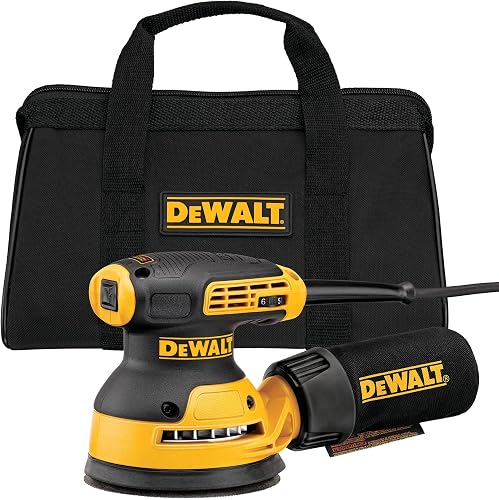
DEWALT DWE6423 5-Inch Random Orbit Sander
8.9/10 our score
See it on Amazon -
2
 Best for cordless deck work
DEWALT DCW210B 20V MAX Cordless Orbital Sander
8.8/10 our score
See it on Amazon -
3
 Best for smooth finish work
Bosch ROS20VSC 5-Inch Random Orbit Sander
8.7/10 our score
See it on Amazon
- 4
 Check it
Metabo HPT SB8V2 3 x 21 Inch Belt Sander
Best for broad, rough boards - 5
 Check it
Bosch GET75-6N 6-Inch Random Orbit Sander
Best for heavy stock removal - 6
 Check it
DEWALT DWE6401DS 5-Inch Rotary Sander
Best for high-torque sanding - 7
 Check it
Makita BO5031K 5-Inch Random Orbit Sander
Best for controlled start-up - 8
 Check it
Metabo HPT SV13YST 5-Inch Random Orbit Sander
Best for a comfortable grip
How we chose a sander for deck boards
The best sander for deck boards depends on the surface condition and the finish you want. We compared sanding style, pad or belt size, speed control, dust collection and the stated operating modes.
A 5-inch random orbit model is a useful middle ground for many deck jobs because it balances coverage with control. A belt sander can cover broad boards more quickly, while a larger dual-mode orbital model gives you a more aggressive setting when standard orbit action is too slow.
The scores reflect how each tool's stated features fit deck preparation and finishing. They don't replace choosing the right abrasive or using a steady technique.
| Product | Best for | Sanding style | Speed | Power | Our score |
|---|---|---|---|---|---|
| DEWALT DWE6423 5-Inch Random Orbit Sander | balanced deck prep | 5-inch random orbit | 8,000–12,000 OPM | Corded electric | 8.9 |
| DEWALT DCW210B 20V MAX Cordless Orbital Sander | cordless deck work | 5-inch random orbit | 8,000–12,000 OPM | 20V MAX battery | 8.8 |
| Bosch ROS20VSC 5-Inch Random Orbit Sander | smooth finish work | 5-inch random orbit | 7,500–12,000 OPM | Corded electric | 8.7 |
| Metabo HPT SB8V2 3 x 21 Inch Belt Sander | broad, rough boards | 3 x 21-inch belt | Variable speed dial | 9-amp motor | 8.7 |
| Bosch GET75-6N 6-Inch Random Orbit Sander | heavy stock removal | 6-inch dual-mode random orbit | Corded electric | 8.6 | |
| DEWALT DWE6401DS 5-Inch Rotary Sander | high-torque sanding | 5-inch rotary disc | 0–3,700 OPM | Corded electric | 8.3 |
| Makita BO5031K 5-Inch Random Orbit Sander | controlled start-up | 5-inch random orbit | 4,000–12,000 OPM | Corded electric | 8.2 |
| Metabo HPT SV13YST 5-Inch Random Orbit Sander | a comfortable grip | 5-inch random orbit | Corded electric | 7.8 |
Which sander fits each deck job?
These picks cover general preparation, cordless movement, broad-board removal and finish sanding. Choose based on the work you need to do, not on motor power alone.
DEWALT DWE6423 5-Inch Random Orbit Sander: Best for balanced deck prep
- 5-inch random orbit pad
- Variable speed from 8,000 to 12,000 OPM
- Dust bag and dust collector connection
Variable speed and a 5-inch pad make this a flexible choice for sanding deck boards and smoothing between prep steps. It includes a locking dust bag and can connect to compatible DEWALT dust collectors.
Pros
- Variable speed
- Counterweight design reduces vibration
- Low profile brings the sander closer to the work
Cons
- Cord limits movement around a large deck
- Dust collector connection may need an adapter for other vacuum systems
The DWE6423 is the strongest general-purpose fit here because its 5-inch random orbit pad combines useful coverage with variable speed. The range runs from 8,000 to 12,000 OPM, so you can adjust the pace for a rougher prep pass or a lighter smoothing pass.
A separate counterweight design reduces vibration, and rubber overmold covers key grip areas. The shorter height also brings you closer to the work surface, which helps when maintaining even contact on a board.
The one-handed locking dust bag collects debris, and the port is designed for DEWALT DWV010 or DWV012 dust collectors. For other vacuum systems with 1-1/4-inch hoses, DEWALT specifies a DWV9000 universal quick connector.
Choose this sander for a mix of board-face prep and finish smoothing when a cord is practical. Skip it if you need to move freely across a large deck and don't want to manage an extension cord.
DEWALT DCW210B 20V MAX Cordless Orbital Sander: Best for cordless deck work
- 5-inch random orbit pad
- Variable speed from 8,000 to 12,000 OPM
- Battery and charger sold separately
This cordless random orbit sander offers a similar stated speed range to the corded top pick, with freedom to move across a deck without a cord. The battery and charger are sold separately.
Pros
- Cordless operation
- Brushless motor
- Dust-sealed switch and locking dust bag
Cons
- Battery and charger are separate
- Dust port may need an adapter for other vacuum systems
The DCW210B suits deck work where cord routing would get in the way. Its brushless motor and variable 8,000 to 12,000 OPM control offer a similar stated speed range to the corded DWE6423.
The low-profile body brings the pad close to the work surface, and its replaceable 8-hole hook-and-loop pad makes paper changes simple. A locking dust bag is included, and the dust port is designed for compatible DEWALT collectors.
The tool is sold without a battery or charger. Choose it if you already use DEWALT 20V MAX batteries or value moving around without a cord; skip it if you need a complete power setup and don't want to buy those parts separately.
Bosch ROS20VSC 5-Inch Random Orbit Sander: Best for smooth finish work
- 5-inch random orbit pad
- Variable speed from 7,500 to 12,000 OPM
- Microfilter dust canister
The ROS20VSC combines variable speed with a pad dampening system designed to reduce swirl marks. Its microfilter canister detaches for emptying, and the kit includes a vacuum adapter.
Pros
- Variable speed
- Pad dampening system
- Dust canister and vacuum adapter included
Cons
- Cord limits reach
- A 5-inch pad can take longer on wide boards than a belt sander
The ROS20VSC is a good fit for finish work where swirl marks are a concern. Its pad dampening system is designed to reduce swirl marks on flat and contoured surfaces, and the speed range runs from 7,500 to 12,000 OPM.
The 5-inch hook-and-loop disc attaches quickly. Bosch includes a microfilter dust canister that detaches for emptying, plus a vacuum adapter and carrying bag.
Choose this corded model for smoothing after rough areas have been leveled, especially when you want an onboard dust canister and a vacuum connection option. Skip it if broad, rough boards need fast removal, since a 5-inch pad takes more passes than a belt.
Metabo HPT SB8V2 3 x 21 Inch Belt Sander: Best for broad, rough boards
- 3 x 21-inch belt
- Variable speed dial
- Dust collection bag
A belt sander is the more direct fit when broad deck boards need faster stock removal. The clear front cover improves visibility near a surface, while the side-mounted dust bag is designed to aid corner sanding.
Pros
- Wide sanding belt
- Variable speed dial
- Clear front cover
Cons
- More aggressive sanding needs a steady, even pass
- Heavier than the 5-inch random orbit picks
The SB8V2 is the pick for broad boards that need faster stock removal. Its 3 x 21-inch belt spans more surface than the 5-inch orbital pads, and the variable speed dial lets you adjust the pace.
The clear front cover improves visibility when sanding near a surface. Its dust bag mounts on the left, a placement designed to help with corner sanding and reduce airborne particles.
Choose this belt sander when the deck has broad, flat areas with substantial wear or old finish to remove. Skip it for light finish smoothing, narrow details or work that calls for a forgiving tool, because belt action removes material quickly and needs a controlled, level pass.
Bosch GET75-6N 6-Inch Random Orbit Sander: Best for heavy stock removal
- 6-inch pad
- Random orbit and turbo modes
- Vacuum-based dust collection
The larger pad and turbo mode suit users who want more stock removal than a standard random orbit setting provides. Dust collection requires a vacuum and hose.
Pros
- Two sanding modes
- 6-inch pad covers more area per pass
- Multi-hole pad accepts a variety of abrasive discs
Cons
- Vacuum and hose needed for dust collection
- Large pad can be less convenient near narrow edges
The GET75-6N suits users who need standard sanding and a more aggressive removal mode in one tool. Its 6-inch pad covers more area per pass than a 5-inch pad, while turbo mode uses direct-drive eccentric orbit action for faster stock removal than standard random orbit mode.
Dust collection requires a vacuum and hose. The package includes two vacuum hose adapters, a front handle and a multi-hole pad system that accepts a variety of abrasive discs.
Choose it if you have suitable vacuum extraction and need the option to move from normal sanding to more aggressive work. Skip it if you want a self-contained dust bag or mostly need to reach narrow edges and stair details.
DEWALT DWE6401DS 5-Inch Rotary Sander: Best for high-torque sanding
- 5-inch disc
- 6-amp motor
- Variable speed from 0 to 3,700 OPM
This rotary sander has a 6-amp motor and a dust shroud that can connect to a vacuum. Its side handle gives you another grip point for controlling the tool.
Pros
- Variable speed trigger dial
- Adjustable dust shroud
- Side handle
Cons
- Rotary action calls for careful control to avoid uneven sanding
- Cord limits movement
The DWE6401DS is a rotary disc sander for users who want a high-torque sanding tool. It has a 6-amp motor, a 5-inch disc and a variable speed trigger dial from 0 to 3,700 OPM.
A mid-handle design, soft grip and side handle provide multiple grip points. The adjustable dust shroud can connect to a vacuum, which helps manage debris while you work.
Choose this model if you are comfortable controlling rotary action and need a tool for high-torque sanding applications. Skip it as your first choice for a broad deck finish pass, where a random orbit sander is easier to manage evenly.
Makita BO5031K 5-Inch Random Orbit Sander: Best for controlled start-up
- 5-inch random orbit action
- Variable speed from 4,000 to 12,000 OPM
- Pad control system
The pad control system manages pad speed at start-up, and the variable dial gives you a broad speed range. Its through-the-pad dust collection helps keep sanding debris under control.
Pros
- Wide variable speed range
- Controlled pad speed at start-up
- Dust collection through the pad
Cons
- Cord limits reach across a deck
- A 5-inch pad takes more passes on broad boards
The BO5031K gives you a wide speed range, from 4,000 to 12,000 OPM, and a pad control system that manages pad speed at start-up. That controlled start is useful when you want to set the tool on the board before bringing it up to working speed.
Dust collection works through the pad, and the sander uses quick-change 5-inch, 8-hole hook-and-loop discs. Makita describes its sealed switch as helping limit dust entry.
Choose it for controlled starts and variable-speed sanding across board faces. Skip it if cordless movement is a priority or you need to strip a large deck quickly; the cord and 5-inch pad make those jobs less convenient.
Metabo HPT SV13YST 5-Inch Random Orbit Sander: Best for a comfortable grip
- 5-inch random orbit pad
- Variable speed dial
- Dust collection hose connector and adapter
This compact palm-style sander has a soft grip and variable speed dial for finish work. The kit includes sanding paper, a dust bag, a hose connector and adapters.
Pros
- Soft comfort grip
- Dust-sealed switch
- Sanding paper and dust bag included
Cons
- 5-inch pad requires repeated passes on large areas
- Cord limits movement
The SV13YST is a compact 5-inch random orbit sander for finish work and smaller deck sections. Its 2.8-amp motor, variable speed dial and soft comfort grip suit jobs where a steady palm hold matters.
The kit includes sanding paper, a dust bag, a hose connector and adapters. Its hook-and-loop pad supports quick paper changes, and the dust-sealed rocker switch helps protect the switch from dust.
Choose this model for touch-ups and smoothing on a smaller area, especially if you want the included paper and dust-collection accessories. Skip it for a large deck with heavy coating removal, where its pad requires repeated passes.
How do you choose the best sander for deck boards?
Start with the condition of the wood, then choose the sanding action that matches the work. A 5-inch random orbit sander is the most flexible choice for typical prep and finish smoothing, while a belt sander is better suited to faster removal across broad, flat boards.
For a lightly weathered deck with raised fibers or worn finish, an orbital model gives you control as you smooth the surface. If the boards have thicker, stubborn coating or uneven areas, a belt sander or dual-mode sander can remove material faster, but it calls for more care.
Consider how much of the deck you need to sand. A larger pad or belt can cover more area per pass, but a smaller pad is easier to guide around posts, edges and narrow spaces.
Should you choose a belt or random orbit sander for a deck?
Choose a random orbit sander for balanced control and a blended finish; choose a belt sander when the main need is faster stock removal on wide, flat boards. The tools suit different stages of the job, so a rough removal pass and a finish pass may call for different sanders.
A belt can remove wood quickly, but it can also create low spots if you pause, tilt it or press too hard. A random orbit sander is more forgiving for smoothing and lighter preparation, although its smaller pad can take longer across a large area.
If you want a closer comparison of these sanding styles, see our belt sander vs orbital sander guide. For projects beyond deck work, our best belt sanders for wood projects covers more belt-style options.
What should you prepare before sanding a deck?
Clear the deck, inspect the boards, and plan how you'll manage cords and dust before you switch on the sander. Move furniture and loose items, then check for raised nails or screws that could catch the abrasive or damage the pad.
Choose an abrasive suited to the coating and wood condition. Start with a less aggressive approach on a small, inconspicuous spot, then inspect the surface before continuing across the deck.
Keep protective eyewear and a suitable dust mask on hand. A dust bag or vacuum connection can help collect debris, but it doesn't replace personal protection or cleanup.
How should you set up a deck sander?
Fit an abrasive disc or belt that matches the tool, check that it is seated correctly, and attach the dust bag or vacuum connection before sanding. For a vacuum connection, confirm that the hose fits the sander's port or use the connector specified for that model.
If using a corded sander, route the cord behind you and away from the sanding path, steps and rails. For a cordless model, start with a charged battery and have a spare ready if the deck is large.
Set a moderate speed when the tool offers variable control, then make a short pass to check how quickly it removes material. Change the speed or abrasive only after seeing how the wood responds.
How do you sand deck boards without leaving marks?
Keep the pad flat and the sander moving steadily with the grain, using light pressure rather than forcing the tool. Overlap each pass slightly so you don't leave untreated strips between lanes.
Start and stop the sander with the pad on the board, and avoid lingering in one spot. A belt sander needs especially careful movement because its faster removal can leave dips if you pause or tilt the tool.
Check the wood from different angles in good light as you work. Sanding dust can hide scratches, so clear it away before deciding whether the surface needs another pass.
What common deck sanding mistakes should you avoid?
The most common mistakes are using too aggressive an abrasive, pressing down hard, and holding the tool in one place. These habits can remove too much wood or create uneven areas that show through the next finish.
Don't assume that a powerful or large sander is automatically faster for every part of the deck. A belt may suit broad boards, but it can be awkward near edges, posts and steps, where a smaller orbital sander or hand sanding gives you more control.
Don't apply stain or sealer over sanding dust. Follow the finish maker's surface-preparation instructions, remove debris, and let the wood dry as directed.
Which sander is best for removing old deck stain?
A belt sander or a dual-mode sander can remove material faster from flat boards with thick or worn coating. That extra cutting action also raises the risk of gouges, so use a light touch and check a small, inconspicuous area first.
For thin residue or light surface wear, a random orbit sander gives you more control. If the coating is peeling or uneven, scraping or cleaning may be needed before sanding.
Don't sand paint or an unknown old coating until you know whether it may contain lead. The U.S.
Environmental Protection Agency explains lead-safe work practices for renovation and repair projects.
How do you manage dust and care for a deck sander?
Use the dust bag or a compatible vacuum connection, and empty the collector before it becomes full. After sanding, unplug a corded sander or remove its battery before cleaning dust from the tool's exterior and checking the pad or belt.
Keep the abrasive clean and replace it when it stops cutting effectively. A worn disc or belt can make you press harder, which can reduce control and leave an uneven finish.
Store the sander and accessories in a dry place, and keep sanding discs, belts and the dust bag free of accumulated debris. Check the tool's instructions for any model-specific cleaning or maintenance steps.
Which deck sander should you choose?
Choose the DEWALT DWE6423 for a flexible corded sander that handles general deck prep and finish smoothing. Pick the Metabo HPT SB8V2 for broad, rough boards, or the DEWALT DCW210B if cordless movement is your priority.
For a smooth finish pass, consider the Bosch ROS20VSC; for a larger pad and turbo removal mode, choose the Bosch GET75-6N if you have vacuum extraction. Match the tool to the work, then follow the stain or sealer directions for surface preparation.
If your next project involves cutting or grinding instead of sanding, see our angle grinder guide for size and tool-selection basics.
Our top 3 picks at a glance
-
1
Best for balanced deck prep
DEWALT DWE6423 5-Inch Random Orbit Sander
8.9/10 our score
See it on Amazon -
2
Best for cordless deck work
DEWALT DCW210B 20V MAX Cordless Orbital Sander
8.8/10 our score
See it on Amazon -
3
Best for smooth finish work
Bosch ROS20VSC 5-Inch Random Orbit Sander
8.7/10 our score
See it on Amazon
Frequently asked questions
What type of sander is best for a deck?
A 5-inch random orbit sander is a practical all-around choice for deck boards because it can remove worn finish and smooth wood while leaving a blended surface. For faster stock removal across broad, rough boards, consider a belt sander and keep it moving evenly.
Use a detail sander or sanding block for tight corners and edges.
Can you use a belt sander on a deck?
Yes. A belt sander can remove material quickly from broad, flat deck boards, but it can also leave low spots if you pause or tilt it.
Keep the tool moving with the grain, use a suitable abrasive, and check the surface often.
A random orbit sander is easier to control for final smoothing.
What grit should you use to sand a deck?
Start with an abrasive coarse enough to remove loose finish or raised fibers, then move to a finer grit for the finish pass. The right starting grit depends on the wood and how much coating remains.
Check the deck stain or sealer instructions before sanding, since a very smooth surface may affect how well some finishes bond.
Should you sand a deck before staining it?
Sand a deck when boards have splinters, rough fibers, or old finish that needs removal. After sanding, remove dust and let the wood dry as directed before applying stain.
Follow the stain maker's surface-preparation instructions, since some products call for cleaning or other steps as well.
How do you control dust when sanding a deck?
Use the sander's dust bag or connect a compatible vacuum when the tool supports it. Wear suitable eye protection and a dust mask, and keep other people away from the work area.
Outdoor airflow helps disperse dust, but it does not replace protective gear or cleanup.